
Poor concrete curing - an example
Everyone knows that good concrete curing is important. But what if it isn't cured as well as it should be?
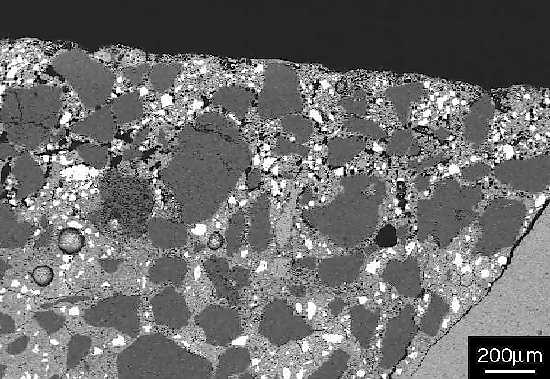
Figure 1 shows an image taken using a scanning electron microscope of a polished section of a piece of a core taken from a UK road bridge constructed in the 1970s. The top of the concrete in the image is the original surface of the concrete.
The black regions in the image are epoxy resin used to prepare the polished section; the small black regions within the concrete are pores that were filled with epoxy resin during specimen preparation.
The small bright particles are unhydrated cement grains. From the concrete surface to a depth of about 1 mm, numerous unhydrated cement grains are visible and the paste fraction of the concrete is highly porous; below 1mm depth, the paste becomes much denser and unhydrated cement grains are scarce.
Clearly, some hydration had occurred near the surface after placing, but the concrete surface was allowed to dry prematurely. At depths greater than about 1 mm, the cement hydrated normally, resulting in a dense paste, but cement hydration in the top millimetre or so stopped due to lack of water, with the pores representing the spaces occupied by the water before it evaporated.
What I think is of particular interest is that cement hydration did not resume in the intervening years. Rain is not entirely unknown in Britain and the concrete surface would have been exposed to rain and spray from vehicles. Despite this, the thin, but dense, rims of hydration product around the cement were evidently sufficiently impermeable to prevent further hydration. The poor concrete curing has resulted in a permanently defective microstructure.
The porous surface seems to have had no adverse consequences for this particular concrete and would have been of no structural significance in this instance. However, porous surface regions of concrete are prone to damage generally and by abrasion or frost action in particular, producing an unsightly appearance. Where aesthetics are important, decorative concrete for example, any such damage would probably be unacceptable. Inadequate curing that affected the bulk of any concrete, not just the surface, would obviously have a detrimental effect on strength, with possible structural implications.
Of course, I'm not saying that hydration could never re-start in all cases of poor concrete curing; there are many variables, perhaps the most important of which is the elapsed time between dehydration and re-wetting. Broadly, though, once the concrete surface has dried, and what might be termed a "desiccated microstructure" has become established, a resumption of full normal hydration is unlikely to occur. The concrete surface region may remain permanently porous, as in this instance, and may need remedial work. It is clearly much easier to cure it properly in the first place.